Electric refuse trucks aren’t just on the horizon anymore. They’re here now, they’re working real routes, and crews are putting them to the test every single week with remarkable success. If you run a waste collection business in the Southeast, that future has a name now: the McNeilus Volterra™ platform, available through Ten-8 Industrial.
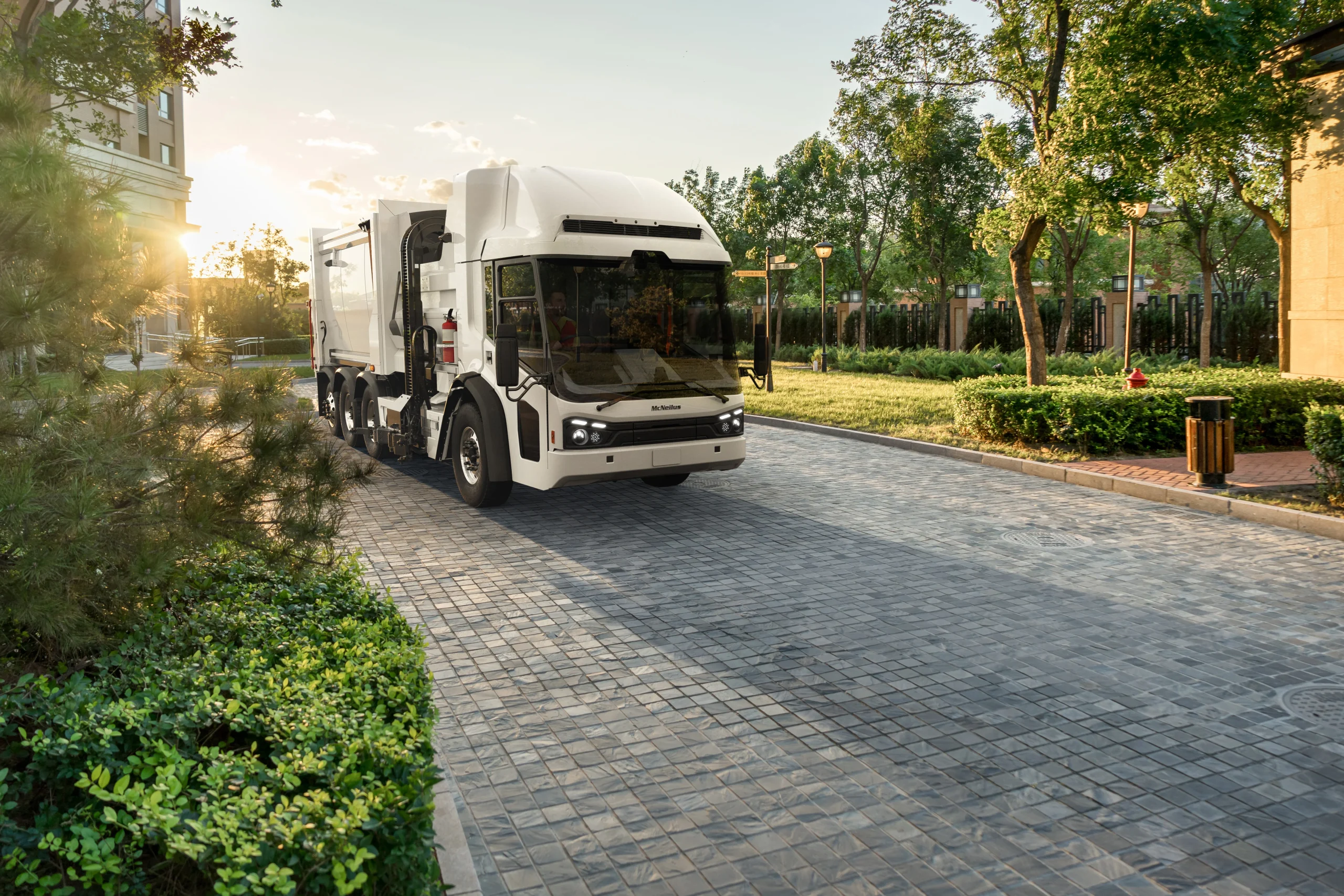
Let’s be honest, this isn’t just a diesel truck with batteries bolted on. Volterra is a purpose-built electric refuse platform with a completely integrated chassis and body. It’s designed from the ground up for stop-and-go collection work.
If you’re trying to sort out what that really means for your fleet, your operators, and your budget, then please continue reading this article as we walk you through the basics.
Why Refuse Is a Natural Fit for Electric
Not every heavy-duty vocation is ready for battery electric right now. Refuse is one of the exceptions.
Collection routes check a lot of boxes that make electrification work in the real world:
- Predictable daily mileage. Most routes have a known distance and return to base every day.
- Intense stop-and-go driving. Electric drivetrains like stop-and-go because regenerative braking recovers energy every time you slow down.
- Return-to-base operations. Trucks come back to the same facility, which makes it much easier to set up depot charging.
That’s exactly the use case the Volterra platform was built around and for. Advanced lithium-ion batteries and an electric axle are engineered to deliver a full day of collection on a single charge in many cases. With a full day charge, you won’t be faced with babysitting all day.
Meet the Volterra Platform: ZSL and ZFL
When Ten-8 talks about the Volterra platform, we’re really talking about a family of electric refuse vehicles that share the same purpose-built chassis. They have a fully integrated design: the chassis and body are engineered together rather than pieced together after the fact.
Right now, that platform includes:
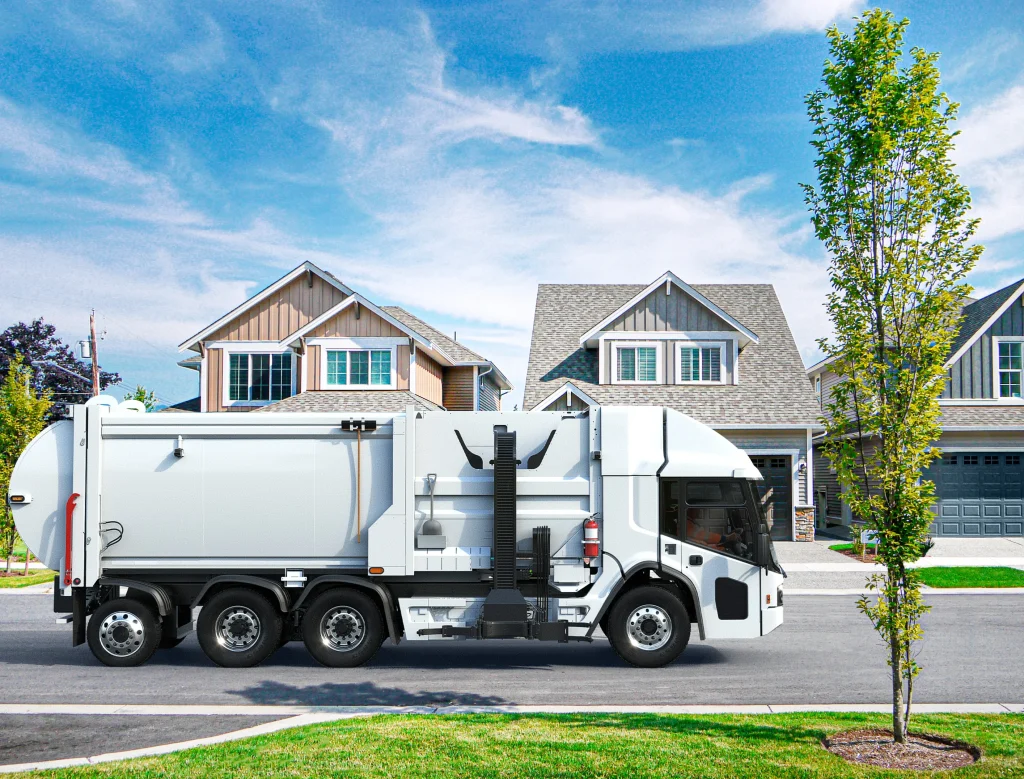
- Volterra ZSL™ – North America’s first fully integrated electric refuse and recycling collection vehicle, a side loader designed for cart-based routes and automated collection.
- Volterra ZFL™ – A fully electric front loader for commercial routes, built on the same platform and leveraging the proven Meridian™ body.
Both are certified as zero-emission vehicles by the U.S. EPA and the California Air Resources Board (CARB), which helps fleets meet aggressive clean-fleet and sustainability targets without reinventing their entire operations overnight.
Driver-First Design: It Has to Work in the Cab
You can talk about batteries and kilowatts all day, but if drivers hate the truck, it’s not going to be a success, so you need to consider how your drivers feel about their trucks.
The Volterra platform was built with a driver-first mindset:
- Huge cab space. The ZSL offers nearly 38% more cab space than a typical refuse cab, which matters on long, hot days when drivers live in that space.
- Low 15″ step height. The step is about two inches lower than the industry standard, making it easier and safer to get in and out repeatedly.
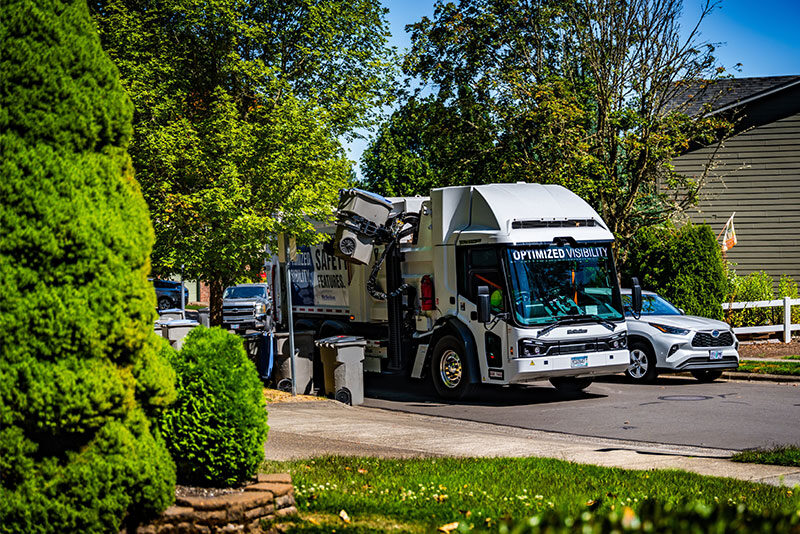
- Direct visibility. Large glass and an integrated cab layout give drivers a direct view of what’s happening around them, instead of relying only on mirrors.
- Clean, integrated controls. Joystick, screens, and controls are laid out as a single system, not scattered aftermarket add-ons.
That focus on ergonomics and visibility isn’t just about comfort. It’s also about safety, fatigue, and long-term retention.
Built-In Safety Tech: ADAS Comes Standard
Refuse routes are some of the most complex driving environments out there: kids on bikes, parked cars, blind corners, and impatient commuters who don’t always respect big trucks. Volterra leans heavily on advanced driver-assistance systems (ADAS) to help.
From the factory, Volterra trucks include features like:
- Blind-spot monitoring
- 360° camera view
- Forward and rear collision alerts
- Lane departure warning
- Rear cross-traffic assist
- Park assist and backup camera
- Advanced emergency braking
A large digital instrument cluster and center display provide drivers with real-time information on speed, battery status, regeneration, cameras, and critical alerts, so they’re not hunting through a maze of gauges.
For operations managers and safety teams, this isn’t just cool tech. It’s an opportunity to reduce incidents, support new drivers, and give experienced operators better tools in tight neighborhoods.
Quiet, Zero-Emission Operation: Good for Communities and Compliance
If you’ve ever stood next to a traditional diesel packer on an early morning route, then you know how loud they can be. Electric refuse trucks change that experience for everyone.
Because Volterra uses a fully electric engine, there is absolutely zero diesel engine noise on ideal. Yes, you’ll still hear the hydraulics and compaction, but not the roar of the engine. The noise levels are lower overall.
Another perk is that there are zero tailpipe emissions. It comes with EPA and CARB zero-emission certificates.
For cities and private haulers trying to balance service expectations with community concerns, those two points, quieter streets and cleaner air, are becoming just as important as tonnage and uptime.
Range, Batteries, and Charging: What You Actually Need to Know
The big question everyone asks about electric refuse trucks is always the same: Will it make the whole route? What about charging?
Here’s the short answer for Volterra:
- Designed for a full day’s route on a single charge in many cases. The platform uses advanced lithium-ion batteries and an electric axle system sized for refuse duty cycles. It has regenerative braking, constantly feeding power back into the pack.
- Depot-style overnight charging. Trucks are intended to return to base, plug in, and be ready to go again in the morning, no public fast-charging circus required in most scenarios.
- Smart battery management. Real-time monitoring and telematics help you understand energy use on specific routes and adjust where needed.
The key is doing a little homework up front. Ten-8 can help you map your current routes, look at mileage and stops. We can then match the Volterra spec to your real-world duty cycle instead of guessing.
Performance and Maneuverability: Not a Science Project
Electric or not, a refuse truck has to do the job: grab carts, pack loads, and snake through tight streets without drama.
The Volterra platform leans on proven McNeilus technology to make that happen:
- Zero Radius™ vertical lift arm (ZSL). The side loader arm offers a 6-foot standard reach for tight urban routes and up to 12 feet to reach around parked cars, with more than a decade of field-proven performance behind it.
- Tight turning radius. Depending on configuration, the ZSL turns in roughly 57–67 feet, making cul-de-sacs, alleys, and crowded parking lots much more manageable.
- Meridian™ body on the ZFL. The front loader uses the same heavy-duty Meridian body you already know, integrated with the electric chassis for high compaction and up to an 8,500-pound lift capacity.
In other words, you’re not trading away productivity to go electric. Instead, you’re bringing your routes into a modern electric platform that still behaves like a work truck.
Total Cost of Ownership: It’s Not Just About Fuel
Yes, electric trucks save fuel. However, that’s only part of the story.
McNeilus positions the Volterra ZSL as capable of reducing the total cost of ownership by an estimated double-digit percentage compared to traditional refuse trucks. Without a doubt, it stands out for its lower fuel costs, fewer drivetrain moving parts, and condition-based maintenance backed by real-time vehicle data.
For many fleets, the TCO picture includes:
- Less money spent on diesel
- Fewer oil changes and engine-related repairs
- Reduced brake wear because regenerative braking is doing much of the work
- Potentially lower costs tied to emissions compliance over time
Is the upfront investment higher than a conventional truck? Usually, yes. However, think about it this way, when you spread that cost over the life of the vehicle and factor in lower operating and maintenance costs, then the math starts to look very different.
Ten-8 can help you run that analysis with your own numbers instead of generic assumptions.
Real-World Momentum: This Platform Isn’t Experimental
If you’re wondering whether Volterra is still “early adopter” territory, it’s worth knowing who’s already buying in.
- Major national haulers have placed orders for Volterra vehicles as part of their long-term sustainability roadmaps.
- The Volterra ZSL has already picked up industry-level recognition, including being named the “Coolest Thing Made in Tennessee” for its blend of zero-emission tech and driver-first design.
- McNeilus has taken the truck on a national road tour so fleets can put it through its paces on real routes, not just see it on a show floor.
That kind of adoption and visibility matters. It means you’re stepping into a platform that’s already proving itself. It’s not a prototype that may or may not have support in three years.
What Fleets Should Think Through Before Going Electric
Making the jump to electric refuse trucks doesn’t have to be overwhelming, but it does require a plan.
The fleets that are seeing the most success usually start with questions like:
- Which routes are the best fit?
High-density residential routes with predictable mileage are often the first candidates for an electric refuse truck. - What does our charging footprint look like?
How many trucks will you start with? Where will they park, and what kind of power do you have available at the depot for them? - How will we train drivers and techs?
The trucks are still refuse trucks at heart, but the operating nuances, diagnostics, and safety systems are new. - Who’s our long-term support partner?
With a platform this advanced, a strong dealer relationship is just as important as the truck itself.
Number four is where Ten-8 Fire & Safety and Ten-8 Industrial come in.
Why Ten-8 for Volterra in the Southeast
Ten-8 has been supporting mission-critical vehicles since the 1980s, with eleven service locations across the Southeast. We also have a long track record with fire apparatus, emergency vehicles, and now high-performance refuse trucks.
When you look at Volterra with Ten-8, you’re not just evaluating a truck. You’re lining up the following:
- Spec and route consultation specific to your operation
- Support on charging and infrastructure planning
- Driver and technician training tailored to the platform
- Ongoing parts, service, and telematics support close to home
Electric refuse trucks are a big move. Having a regional partner who understands both the technology and the day-to-day realities of the collection world makes that move much more manageable.
Ready to See Volterra Up Close?
Electric refuse trucks are no longer a “someday” conversation. They’ve become real and are probably in your neighborhood or a neighborhood near you.
The McNeilus Volterra platform brings together:
- Quiet, zero-emission operation
- A driver-focused, safety-packed cab
- Proven refuse bodies and lift systems
- Smart battery and telematics tech
- A total cost of ownership story that can stand up to hard questions
If you’re ready to see what that looks like on your routes, Ten-8 Industrial is prepared to help.
Reach out to the Ten-8 team to schedule a Volterra walk-through, talk TCO with your own numbers, and map out what an electric future for your refuse fleet could look like.